
Web Application Development
Booking System Architecture: Designing Reliable Scheduling Platforms
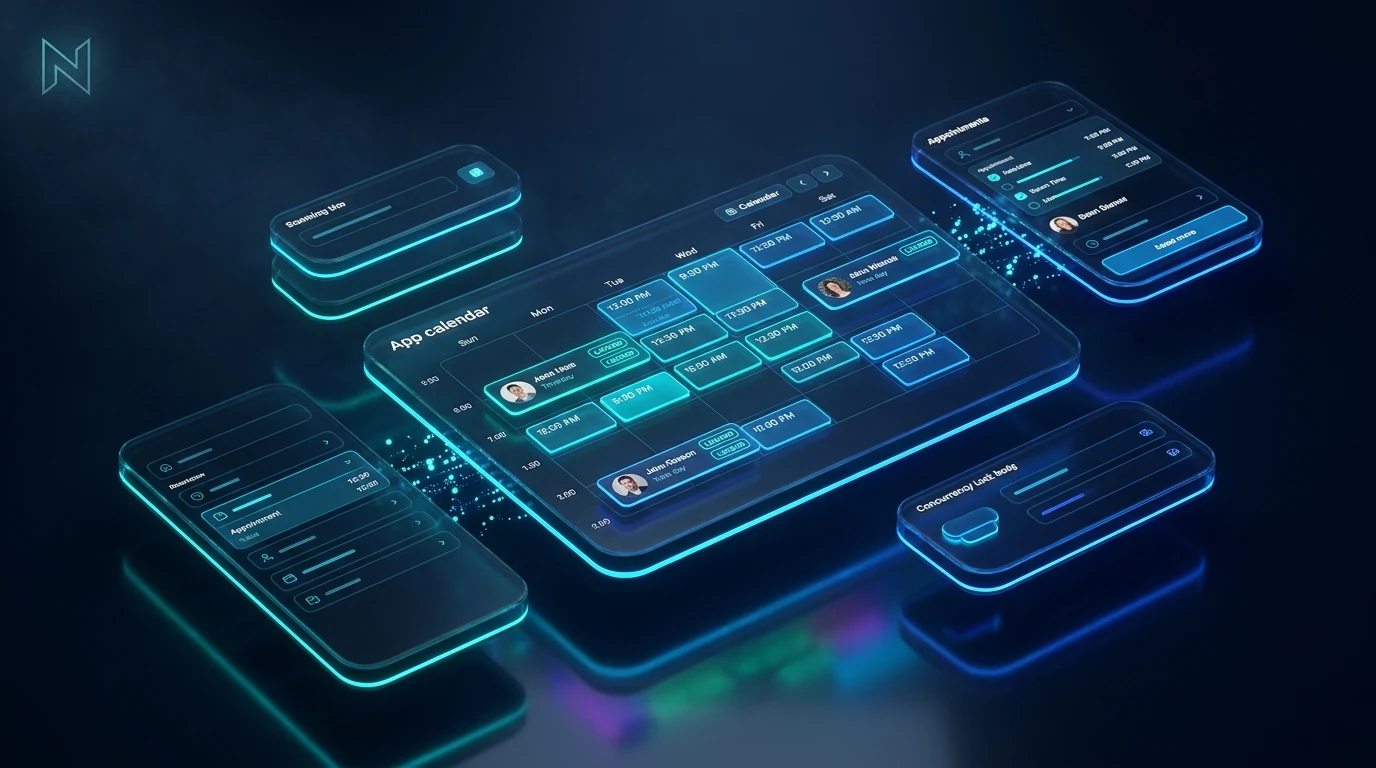
Master the engineering behind appointment booking platforms: distributed concurrency locks, double-booking prevention, time-zone synchronization, and notifications.
On this page
Quick answer
Designing a reliable appointment booking system requires solving complex concurrency, temporal consistency, and state synchronization challenges that off-the-shelf plugins fail to handle under real-world traffic.
The primary technical hurdles are: 1) Preventing race-condition double bookings when multiple users attempt to reserve the same time slot simultaneously; 2) Managing complex time-zone offsets, operating hours, and daylight saving time (DST) shifts; and 3) Synchronizing multi-staff availability with external calendars (Google Calendar, Outlook, iCal).
Production architectures resolve these challenges using database pessimistic locking (SELECT FOR UPDATE) or distributed Redis reservation holds, strict UTC timestamp storage, and transactional notification queues.
The concurrency challenge: Preventing double bookings
A naive booking flow checks if a time slot is open (SELECT available FROM slots WHERE time = :time) and, if open, creates a booking (INSERT INTO bookings ...). In high-traffic environments, two users checking out at the exact same millisecond will both read the slot as open, resulting in an embarrassing double booking.
To guarantee consistency, platforms must enforce atomicity. In PostgreSQL, this can be achieved using transactional row-level locks (SELECT ... FOR UPDATE) or exclusion constraints with date range types (tsrange) that enforce non-overlapping appointment intervals at the database engine level.
Alternatively, an ephemeral reservation hold pattern can be implemented in Redis: when a user initiates checkout, a distributed key is created with a 10-minute TTL. Other users see the slot as temporarily reserved. If the checkout succeeds, the permanent booking record is committed; if payment times out, the lock expires automatically without manual administrative cleanup.
Mastering time zones, buffer times, and daylight saving
Time management is notoriously error-prone in software development. All scheduling databases must store timestamps exclusively in UTC (Coordinated Universal Time) with timezone-aware timestamp types (TIMESTAMPTZ).
Converting to local display time should occur strictly at the presentation layer using the customer's verified IANA time zone identifier (e.g., 'America/New_York' or 'Asia/Dubai'), rather than raw static hour offsets, because daylight saving transitions will cause fixed offsets to drift by an hour twice per year.
Furthermore, real business scheduling requires configurable buffer rules: automated turnaround times between appointments (e.g., 15-minute cleanup intervals), minimum advance notice windows (preventing appointments scheduled 5 minutes before arrival), and maximum booking horizons.
External calendar synchronization and webhooks
Staff members frequently manage personal and professional commitments across external calendars like Google Calendar or Microsoft Outlook. A robust booking platform must maintain bidirectional calendar synchronization.
Outbound synchronization pushes confirmed platform bookings to staff calendars using Google Calendar API or CalDAV protocols. Inbound synchronization listens for external calendar webhooks and marks corresponding platform slots as unavailable if a staff member creates a private event.
To prevent infinite synchronization loops, booking payloads must attach unique deterministic idempotency keys and origin metadata.
Automating the client notification lifecycle
A booking system is only as effective as its communication flow. Missed appointments (no-shows) directly erode revenue in salons, medical clinics, and professional consulting practices.
Production platforms integrate automated transactional notification pipelines: instant booking confirmation, automated calendar invite (.ics attachments), 24-hour reminder SMS/WhatsApp notifications, and post-appointment review requests.
These communications should be managed via background queues (e.g., Redis workers or serverless cron jobs) ensuring that third-party SMS or email API latency never delays the user checkout confirmation screen.
How NUSTFORGE builds custom booking platforms
NUSTFORGE engineers bespoke booking and scheduling software engineered around the exact operational demands of service businesses, salons, clinics, and multi-location enterprises.
Our track record includes live platforms such as the Eva Hair Salon Platform and our multi-tenant Aesthetics Salon SaaS, featuring real-time slot locking, automated WhatsApp reminders, integrated Stripe checkout, and staff management portals.
We build platforms that eliminate double-booking risks, streamline customer conversion, and integrate seamlessly with your existing operational workflows.
Continue reading
Related software guides.
Mobile App Development
React Native vs Flutter: Choosing a Cross-Platform Mobile Development Approach
An objective technical comparison of React Native (New Architecture, Hermes) vs Flutter (Impeller, Dart): performance, hardware access, maintainability, and decision criteria.
Read article
Software Planning
What Does Custom Software Development Cost in 2026?
See what drives custom software development cost in 2026, including features, user roles, integrations, infrastructure, timeline, and support.
Read article
Mobile App Development
Web App vs Mobile App: Which Should Your Business Build First?
Compare web apps and mobile apps by access, features, cost, launch speed, and user behaviour before deciding what your business should build first.
Read articleDesign custom scheduling
Need a reliable, high-volume booking platform?
Build a custom reservation system with double-booking prevention, multi-staff calendar sync, and automated messaging.