
Mobile App Development
React Native vs Flutter: Choosing a Cross-Platform Mobile Development Approach
An objective technical comparison of React Native (New Architecture, Hermes) vs Flutter (Impeller, Dart): performance, hardware access, maintainability, and decision criteria.
On this page
Quick answer
Both React Native and Flutter are mature, industry-proven cross-platform frameworks capable of delivering high-performance, beautiful mobile applications for iOS and Android from a single shared codebase.
Choose React Native if your business already has web developers proficient in React and TypeScript, if you want to share business logic between web and mobile, or if your application relies heavily on native platform UI conventions.
Choose Flutter if your product demands highly customized, pixel-perfect 2D UI designs, smooth 120fps animations across all operating system versions, or if you prefer a unified, batteries-included framework with Google's Impeller rendering engine.
Architecture comparison: Hermes & JSI vs Impeller & Dart
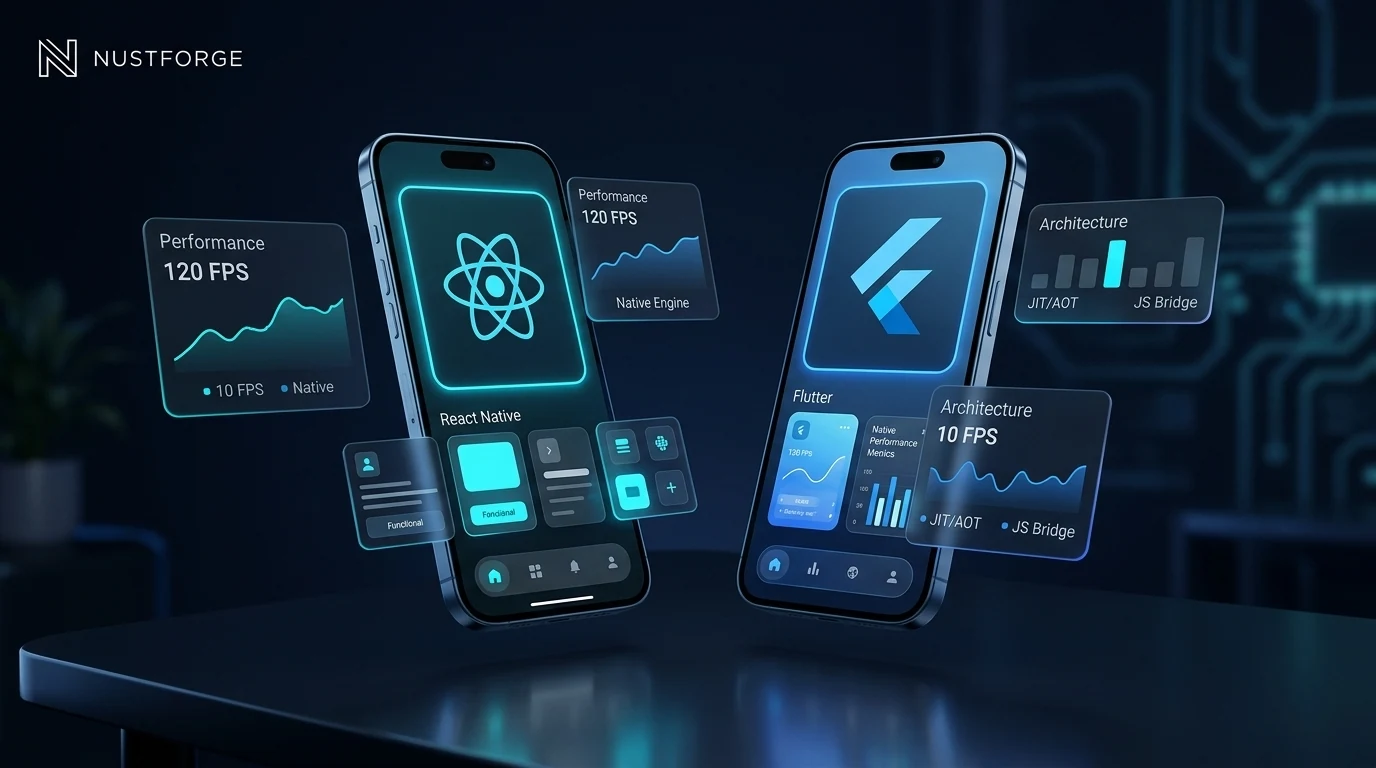
Historically, React Native relied on an asynchronous JSON bridge to communicate between JavaScript and native platform modules, which could cause frame drops during intense gestures or animations. With React Native's New Architecture (Fabric renderer, TurboModules, and the JavaScript Interface / JSI), JavaScript communicates directly and synchronously with native C++ memory using the high-performance Hermes engine, eliminating bridge bottlenecks.
Flutter takes a fundamentally different approach: rather than utilizing native iOS (UIKit) and Android (Android View) widgets, Flutter bypasses the platform UI layer entirely. It compiles Dart code directly to native ARM machine code and draws every pixel on screen using its proprietary Impeller graphics rendering engine.
This grants Flutter complete visual consistency across every device and OS version, while React Native renders actual native platform widgets, automatically inheriting OS-specific styling and accessibility behaviors.
Developer ecosystem, talent pool, and web code sharing
React Native's greatest strategic advantage is the global dominance of TypeScript and React. Millions of developers worldwide write React daily. A company building both a Next.js web application and a React Native mobile app can share significant code: data validation schemas (Zod), API client hooks, state management logic, and formatting utilities.
Flutter requires the Dart programming language. While Dart is clean, strongly typed, and easy for object-oriented developers to learn, the talent pool is substantially smaller than the global JavaScript/TypeScript ecosystem.
For startups and mid-market companies seeking to maintain lean engineering teams, React Native often provides superior hiring flexibility and cross-platform resource sharing.
Hardware access and third-party plugin maturity
Both frameworks provide robust libraries for standard mobile capabilities: camera capture, GPS geolocation, push notifications, biometric FaceID/fingerprint authentication, Bluetooth, and local SQLite storage.
React Native benefits from Expo, which has matured into an exceptional development ecosystem, streamlining native compilation, over-the-air (OTA) updates, and credential management without requiring Xcode or Android Studio for routine feature development.
Flutter benefits from pub.dev, Google's centralized package repository, where official and community plugins are rigorously scored for code health, documentation, and multi-platform compatibility.
The practical 2026 decision matrix
To choose the ideal framework for your business mobile application, evaluate these practical decision factors:
Opt for React Native when: 1) You already have an active React/Next.js web codebase; 2) Your app is primarily forms, feeds, e-commerce, and account management; 3) You want seamless integration with Expo tools; 4) You prioritize native OS UI styling.
Opt for Flutter when: 1) Your product features bespoke, heavily customized, branded UI components; 2) You are building a graphic-intensive tool, game, or custom interactive canvas; 3) You want identical pixel-for-pixel rendering across both modern and legacy Android devices.
How NUSTFORGE delivers cross-platform mobile apps
At NUSTFORGE, our mobile engineering team builds robust, responsive iOS and Android applications using both React Native and Flutter.
Our mobile work includes award-winning applications—such as the DonateNotWaste mobile platform, which took 1st Place at the University EXPO—featuring live GPS tracking, camera AI integrations, and real-time cloud data synchronization.
We guide you through the architectural trade-offs, help you select the ideal framework for your roadmap, and engineer mobile products that users love.
Continue reading
Related software guides.

Mobile App Development
Web App vs Mobile App: Which Should Your Business Build First?
Compare web apps and mobile apps by access, features, cost, launch speed, and user behaviour before deciding what your business should build first.
Read article
Privacy & Security
GDPR and HIPAA in Software Development: Privacy and Compliance Considerations
An engineering overview of technical compliance: AES-256 encryption, immutable audit trails, role-based access, data subject rights, and secure software architectures.
Read article
Software Maintenance
Software Maintenance Contracts: Scope, SLAs, Security and Long-Term Support
What businesses must know about software maintenance: corrective vs preventive updates, SLA response times, dependency vulnerability patching, disaster recovery, and retainer agreements.
Read articleLaunch your mobile product
Deciding between React Native and Flutter for your app?
Let NUSTFORGE evaluate your user experience requirements, hardware integrations, and team roadmap to pick the ideal stack.