
Software Maintenance
Software Maintenance Contracts: Scope, SLAs, Security and Long-Term Support
What businesses must know about software maintenance: corrective vs preventive updates, SLA response times, dependency vulnerability patching, disaster recovery, and retainer agreements.
On this page
Quick answer
A software maintenance contract is a structured commercial and engineering agreement that guarantees the ongoing health, security, uptime, and performance of production software applications after initial launch.
Software is not a static physical asset; it is a dynamic system operating within an evolving digital ecosystem. Without maintenance, software degrades: open-source dependencies develop critical security vulnerabilities (CVEs), third-party APIs (Stripe, Twilio, Google) deprecate endpoints, browser updates introduce visual glitches, and database tables require indexing optimization.
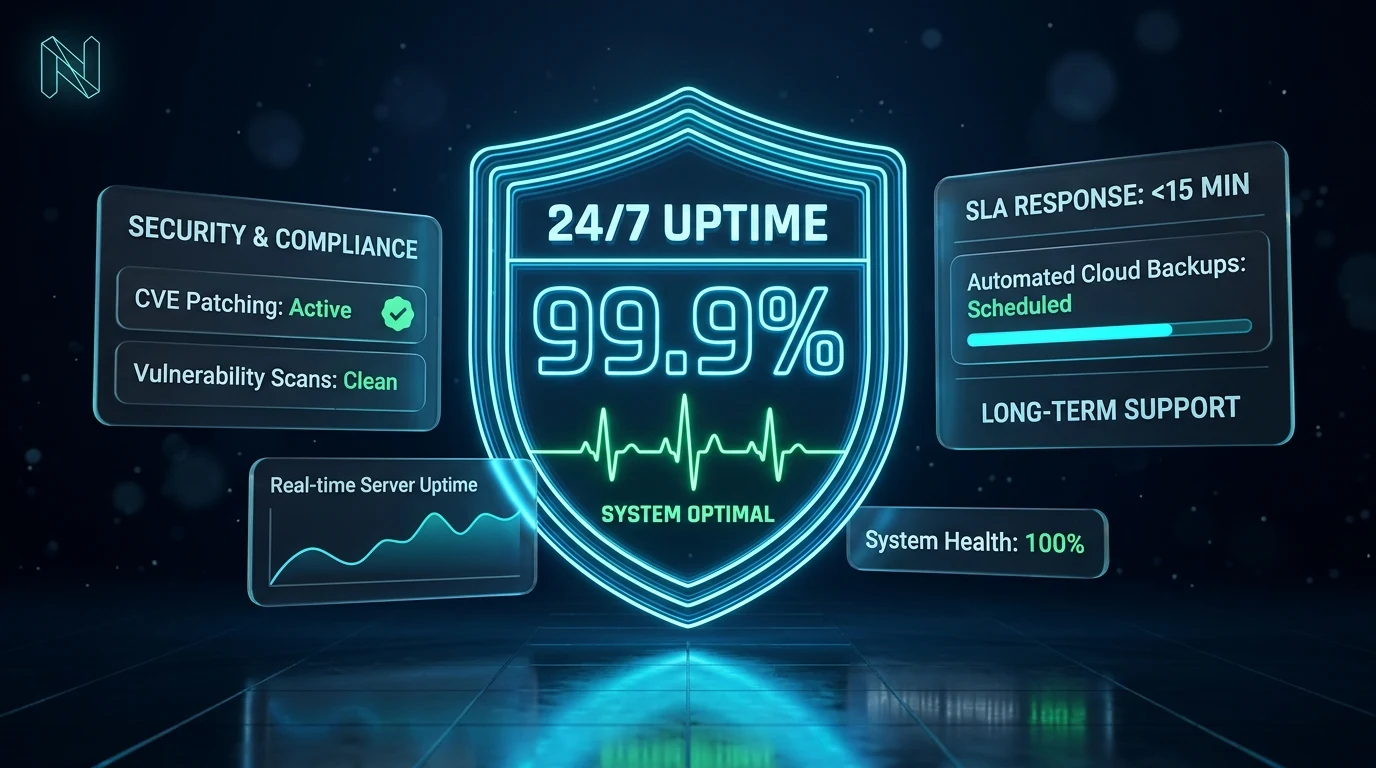
Well-structured maintenance contracts define four maintenance categories (Corrective, Adaptive, Perfective, Preventive), guaranteed SLA response times based on incident severity, regular offsite backups, and proactive security scanning.
The four pillars of software maintenance
In professional software engineering, maintenance encompasses four distinct operational activities: 1) Corrective Maintenance: Investigating and resolving unexpected defects, software bugs, or crashes reported by users or error monitoring systems.
2) Adaptive Maintenance: Modifying software to maintain compatibility with external environmental shifts—such as upgrading Next.js, Node.js, or React runtimes, complying with new mobile OS requirements (iOS/Android releases), or adapting to third-party API version deprecations.
3) Perfective Maintenance: Refining user interfaces, improving database query latencies, enhancing page load times, and making incremental operational adjustments based on user feedback.
4) Preventive Maintenance: Proactively auditing code dependencies for known CVE vulnerabilities, rotating SSL/TLS certificates and API secrets, reviewing database index bloat, and conducting simulated disaster recovery restorations.
Structuring Service Level Agreements (SLAs) by severity
A Service Level Agreement (SLA) defines the engineering team's contractual commitment to respond to and resolve incidents based on their operational severity.
P1 — Critical Outage (e.g., entire website or payment gateway down, data corruption risk): Targeted response time under 1 hour, continuous active triage until resolved.
P2 — Major Degradation (e.g., core booking feature failing, admin dashboard login errors for specific roles, but platform partially operational): Targeted response time under 4 to 8 hours.
P3 — Minor Defect (e.g., visual layout misalignment on specific viewport, non-critical report export glitch, typo in transactional template): Targeted response time within 24 to 48 business hours.
Disaster recovery, backups, and RTO/RPO targets
A comprehensive maintenance agreement must specify exact data protection and disaster recovery parameters.
Recovery Point Objective (RPO): Defines the maximum acceptable age of data that can be lost in a catastrophic disaster. For production business platforms, automated daily or continuous point-in-time recovery (PITR) ensures an RPO of under 1 hour.
Recovery Time Objective (RTO): Defines the maximum allowable duration required to restore infrastructure and bring the platform back online following hardware or cloud failure.
Backups should always follow the 3-2-1 backup rule: three copies of data, across two different storage media, with at least one offsite immutable backup isolated from primary cloud credentials.
Retainer models vs ad-hoc hourly billing
Relying on ad-hoc, pay-as-you-go hourly support for production software is hazardous: when a critical outage strikes on a weekend or holiday, an ad-hoc developer has zero contractual obligation to respond immediately, and may be booked on other projects.
A monthly maintenance retainer reserves dedicated engineering capacity. Retainers typically bundle proactive background monitoring (uptime checks, error logging with Sentry), routine monthly dependency updates, and a dedicated bucket of engineering hours for ongoing minor improvements.
This aligns incentives: your engineering partner is motivated to maintain clean, stable code so fewer emergencies arise, rather than profiting from frequent outages.
How NUSTFORGE maintains production software
NUSTFORGE provides dedicated software maintenance, SLA support, and infrastructure management for mission-critical web applications, SaaS platforms, and enterprise business websites.
Our maintenance retainers feature 24/7 uptime monitoring, automated error capture, continuous security patching, regular database optimization, and guaranteed response SLAs.
We protect your software investment, ensuring your systems remain secure, performant, and fully operational so you can focus on growing your business.
Continue reading
Related software guides.
Privacy & Security
GDPR and HIPAA in Software Development: Privacy and Compliance Considerations
An engineering overview of technical compliance: AES-256 encryption, immutable audit trails, role-based access, data subject rights, and secure software architectures.
Read article
Software Planning
Software Procurement: How Businesses Should Evaluate Development Partners
A practical buyer's guide to evaluating software development agencies: code ownership, architecture audits, milestone SLAs, contract structures, and red flags.
Read article
Mobile App Development
React Native vs Flutter: Choosing a Cross-Platform Mobile Development Approach
An objective technical comparison of React Native (New Architecture, Hermes) vs Flutter (Impeller, Dart): performance, hardware access, maintainability, and decision criteria.
Read articleSecure long-term support
Need dependable SLA maintenance for production software?
Protect your web, SaaS, or mobile platform with proactive security patching, uptime monitoring, and guaranteed response SLAs.