
Privacy & Security
GDPR and HIPAA in Software Development: Privacy and Compliance Considerations
An engineering overview of technical compliance: AES-256 encryption, immutable audit trails, role-based access, data subject rights, and secure software architectures.
On this page
Quick answer
Technical compliance with GDPR (General Data Protection Regulation) and HIPAA (Health Insurance Portability and Accountability Act) requires building Privacy and Security by Design directly into software architecture, rather than attempting to retroactively bolt security onto an existing codebase.
GDPR focuses broadly on individual personal data rights, lawful basis of processing, user consent lifecycle, data minimization, and the right to erasure ('right to be forgotten'). HIPAA focuses specifically on safeguarding Protected Health Information (PHI) in the United States through stringent Administrative, Physical, and Technical Safeguards.
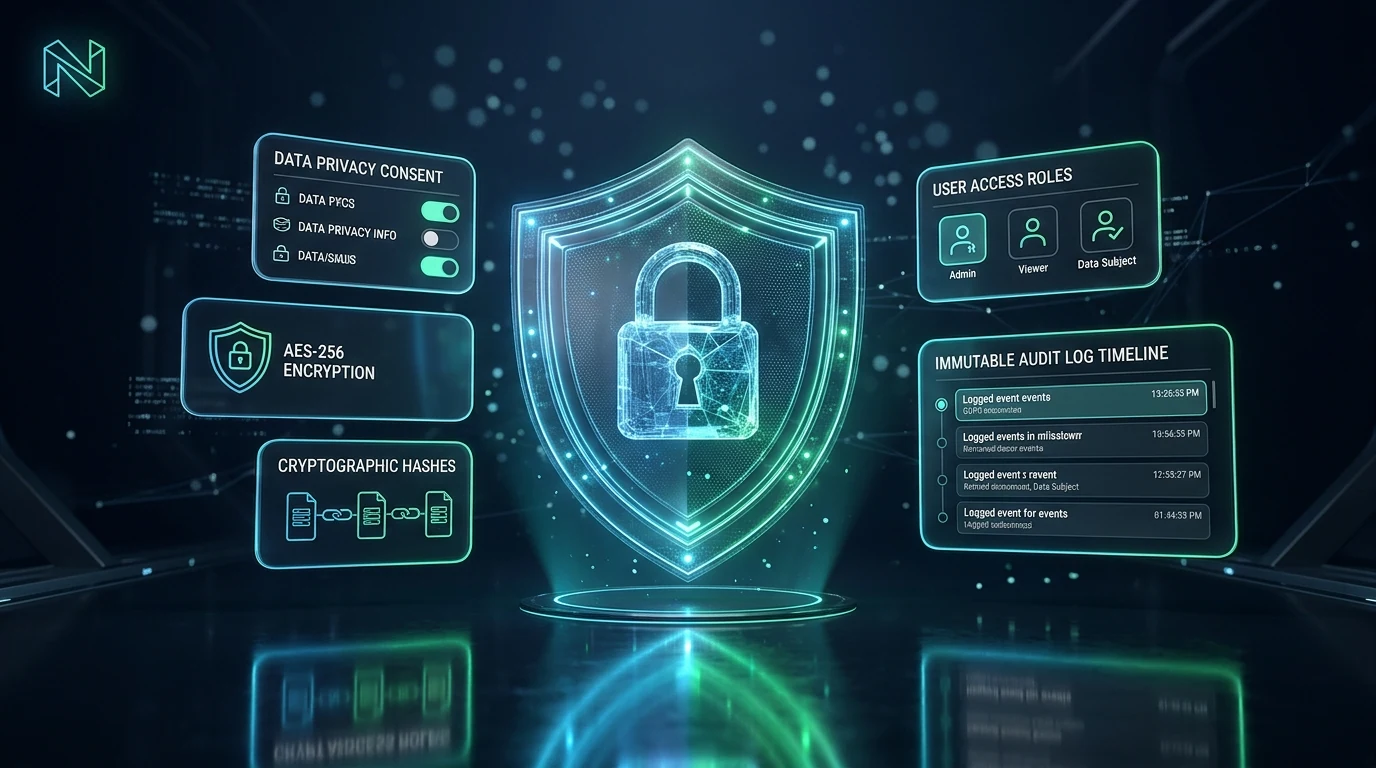
Key technical requirements include end-to-end TLS 1.3 encryption in transit, AES-256 column-level encryption at rest, cryptographically hashed credentials, strict least-privilege access control, and tamper-evident audit logging for every access to sensitive records.
Important disclaimer: Technical architecture vs legal advice
The information presented in this guide represents software engineering best practices, technical architecture patterns, and cybersecurity considerations for digital platforms.
It does not constitute formal legal counsel. Data privacy legislation varies across jurisdictions (UK GDPR, EU GDPR, US federal and state statutes), and organizations should always consult qualified legal counsel to review data protection policies, Business Associate Agreements (BAAs), and regulatory compliance frameworks.
Core architectural requirements for GDPR compliance
GDPR compliance requires software systems to support fundamental data subject rights through automated technical mechanisms. Primary among these are the Right of Access (Article 15) and the Right to Erasure (Article 17).
To support data erasure without corrupting relational database foreign keys or historical financial ledgers, platforms should implement structured pseudonymization or soft-deletion patterns. When a user requests account deletion, identifying fields (name, email, phone, IP) are securely overwritten with anonymized cryptographic hashes while retaining anonymized transactional counters necessary for tax and accounting compliance.
Furthermore, consent management must be explicit, granular, and auditable. Third-party telemetry, marketing trackers, and analytics scripts must remain completely disabled until the user provides affirmative consent via an opt-in banner, with easy mechanisms to revoke consent at any time.
Technical safeguards mandated by HIPAA
Under the HIPAA Security Rule (45 CFR Part 160 and Part 164), covered entities and business associates must implement strict technical safeguards for electronic Protected Health Information (ePHI).
Access Controls (§ 164.312(a)): Every user must possess unique credentials. Generic shared logins are strictly prohibited. Systems must enforce Multi-Factor Authentication (MFA), automatic session timeouts after inactivity, and role-based least-privilege scoping.
Audit Controls (§ 164.312(b)): Platforms must record and examine activity in information systems containing ePHI. Audit logs must capture the exact user ID, timestamp, patient ID accessed, action performed (read, export, edit, delete), and client IP. These logs must be stored in append-only, tamper-evident storage for a minimum of six years.
Transmission and Storage Security (§ 164.312(e)): ePHI must be encrypted using industry-standard protocols: TLS 1.3 in transit with strong cipher suites, and AES-256 encryption at rest for databases, backups, and file storage buckets.
Secure cloud infrastructure and vendor vetting
Software compliance extends beyond your codebase to the third-party infrastructure and sub-processors hosting your application. Deploying HIPAA-compliant software requires signing formal Business Associate Agreements (BAAs) with cloud providers (e.g., AWS, GCP, Vercel Enterprise, Supabase Enterprise).
Databases and object storage must never be exposed to the public internet; they must reside inside private Virtual Private Clouds (VPCs) with strict security groups and IP allowlisting.
For email dispatch and transactional communications, services like Resend or AWS SES must be configured with SPF, DKIM, and DMARC enforcement, ensuring message integrity and preventing phishing vulnerabilities.
How NUSTFORGE builds secure, privacy-first software
NUSTFORGE engineers web applications, portals, and cloud backends with rigorous security and privacy standards from day one.
Our portfolio includes production systems handling sensitive onboarding and commercial data—such as the UCBS Employee Onboarding Portal—featuring encrypted document storage, granular role permissions, and zero-leakage workflows.
We help startups and enterprises design privacy-compliant architectures, implement secure authentication flows, enforce database encryption, and prepare technical infrastructures for independent compliance audits.
Continue reading
Related software guides.
Software Maintenance
Software Maintenance Contracts: Scope, SLAs, Security and Long-Term Support
What businesses must know about software maintenance: corrective vs preventive updates, SLA response times, dependency vulnerability patching, disaster recovery, and retainer agreements.
Read article
Software Planning
Software Procurement: How Businesses Should Evaluate Development Partners
A practical buyer's guide to evaluating software development agencies: code ownership, architecture audits, milestone SLAs, contract structures, and red flags.
Read article
Business Software
Custom Business Dashboards: Features, Architecture and Development Considerations
Discover when to transition from spreadsheets to custom business dashboards, key architectural layers, real-time KPI pipelines, role-based access control, and TCO.
Read articlePrivacy by design
Need compliant software architecture for sensitive data?
Consult with NUSTFORGE on implementing encryption at rest, immutable logging, and GDPR/HIPAA technical safeguards.