
Software Planning
Software Procurement: How Businesses Should Evaluate Development Partners
A practical buyer's guide to evaluating software development agencies: code ownership, architecture audits, milestone SLAs, contract structures, and red flags.
On this page
Quick answer
Software procurement is one of the highest-risk capital allocation decisions a business makes. Choosing the wrong development partner leads to blown budgets, delayed launches, technical debt, and proprietary vendor lock-in.
Businesses should evaluate potential engineering agencies across six concrete criteria: 1) Verified production reference projects; 2) Complete intellectual property (IP) and repository ownership; 3) Modern, maintainable tech stack choices; 4) Milestone-based contract structures with clear acceptance criteria; 5) Transparent sprint communication; and 6) Post-launch warranty and SLA support.
Never evaluate partners solely on initial cost estimates. Low-cost bids frequently hide scope ambiguities, offshore subcontracting, outdated architectures, and costly change-order fees down the line.
Critical red flags in agency proposals
When reviewing software development bids, watch out for these dangerous agency red flags: 1) The 'Yes to Everything' agency: A vendor who agrees to all complex features without probing edge cases, user roles, or scalability constraints is usually sales-driven, not engineering-led.
2) Proprietary CMS Lock-In: Agencies insisting on proprietary website builders or custom internal frameworks effectively hold your business hostage; migrating away later requires a complete rewrite.
3) Vague Fixed-Price Bids Without Discovery: Providing a rigid price on a multi-month project without an initial scoping or technical discovery phase guarantees conflict when scope assumptions inevitably diverge.
4) Delayed Code Access: Any agreement that restricts code access until final payment leaves you vulnerable to abandonment. You should maintain administrative ownership of the GitHub/GitLab repository from day one.
Contract structures: Fixed scope vs agile sprint teams
Understanding contract models is essential for managing project risk and budget expectations.
Fixed-Scope Contracts work best for well-defined, static deliverables (e.g., a corporate marketing website or standard brochure site) where every page, form, and integration is documented prior to kickoff.
Agile Sprint Contracts (or Dedicated Engineering Squads) are vastly superior for custom web applications, SaaS MVPs, and complex portals. Building innovative software requires ongoing iteration as user feedback emerges. Structuring work into 2-week sprints with defined acceptance criteria ensures transparency and allows strategic pivoting without contentious contract amendments.
Verifying technical code quality and standards
Do not rely solely on polished slide decks and portfolio screenshots. A portfolio website can look visually appealing while harboring atrocious, unmaintainable backend code.
Ask prospective development partners technical questions: Do you enforce TypeScript in strict mode? What automated testing pipelines (unit, integration, end-to-end) run in your CI/CD workflows? How do you manage database migrations and rollbacks? What security scanning tools are used for dependencies?
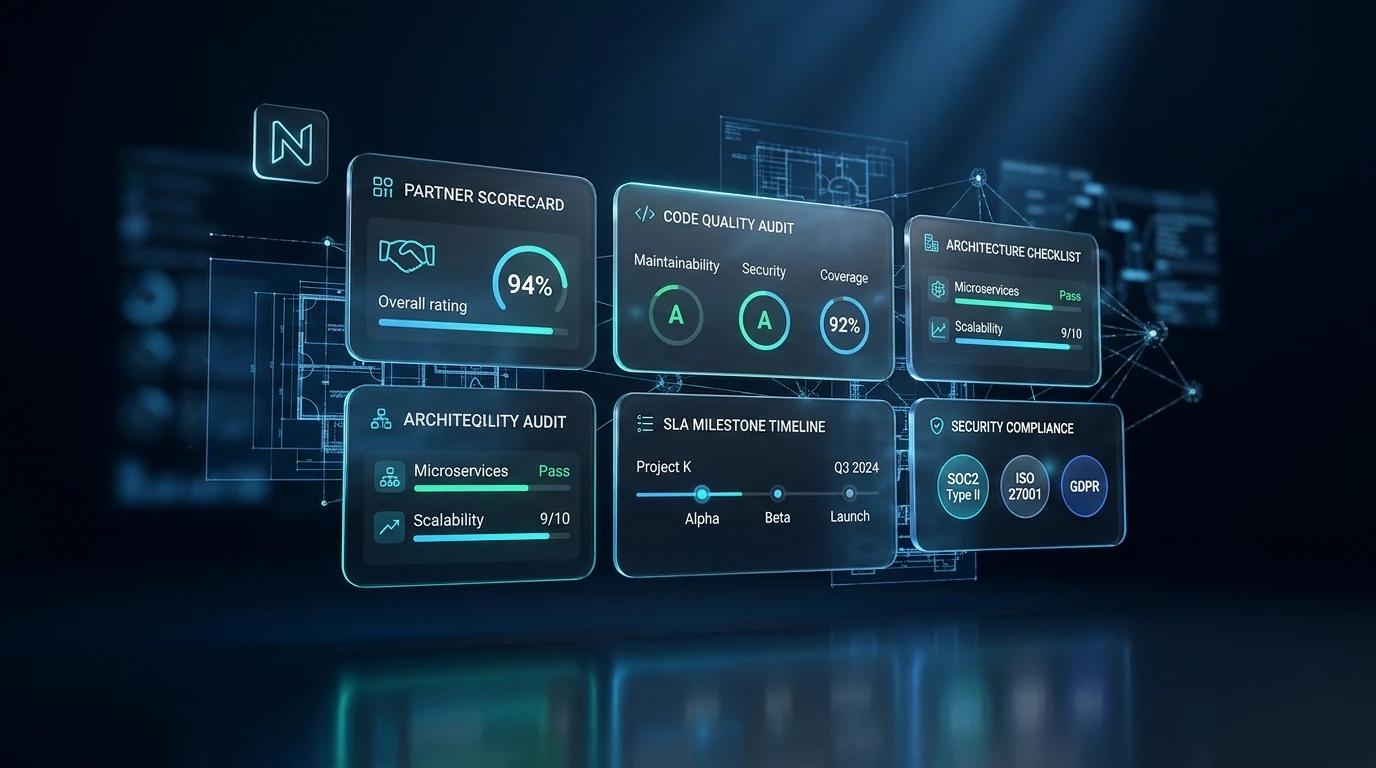
If your organization lacks in-house technical leadership, commissioning an independent third-party technical audit of the agency's proposed architecture before signing can save tens of thousands of dollars.
Post-launch support, SLAs, and knowledge transfer
Software development does not end on launch day. Operating systems, browser standards, third-party APIs, and security packages evolve continuously.
Your procurement agreement must include: 1) A clear warranty period (typically 30 to 60 days) during which verified functional bugs are resolved at no additional charge; 2) Comprehensive technical documentation, architecture diagrams, and deployment runbooks; and 3) An optional ongoing Service Level Agreement (SLA) defining guaranteed response times for critical production issues.
How NUSTFORGE partners with growing businesses
At NUSTFORGE, our procurement and delivery philosophy is built on complete transparency, technical excellence, and client empowerment.
We provide full intellectual property ownership, grant immediate access to clean Git repositories, document every architectural decision, and avoid proprietary vendor lock-in by building on standard modern stacks (Next.js, TypeScript, PostgreSQL, Tailwind CSS).
We offer structured discovery sprints to eliminate scope ambiguity before development begins, ensuring our clients launch on time, within budget, and with complete confidence.
Continue reading
Related software guides.

Software Planning
What Does Custom Software Development Cost in 2026?
See what drives custom software development cost in 2026, including features, user roles, integrations, infrastructure, timeline, and support.
Read article
Privacy & Security
GDPR and HIPAA in Software Development: Privacy and Compliance Considerations
An engineering overview of technical compliance: AES-256 encryption, immutable audit trails, role-based access, data subject rights, and secure software architectures.
Read article
Software Maintenance
Software Maintenance Contracts: Scope, SLAs, Security and Long-Term Support
What businesses must know about software maintenance: corrective vs preventive updates, SLA response times, dependency vulnerability patching, disaster recovery, and retainer agreements.
Read articleIndependent technical review
Need guidance reviewing technical proposals or agency contracts?
NUSTFORGE provides independent technical architecture reviews, scoping audits, and milestone delivery frameworks.