
Custom Software Development
Next.js for Business Applications: Architecture, Performance and Maintainability
Explore why modern enterprises choose Next.js App Router for business portals: Server Components, streaming SSR, edge caching, Core Web Vitals, and type safety.
On this page
Quick answer
Next.js has evolved into the enterprise standard for building modern, high-performance web applications and business software, combining the developer ergonomics of React with production-grade full-stack capabilities.
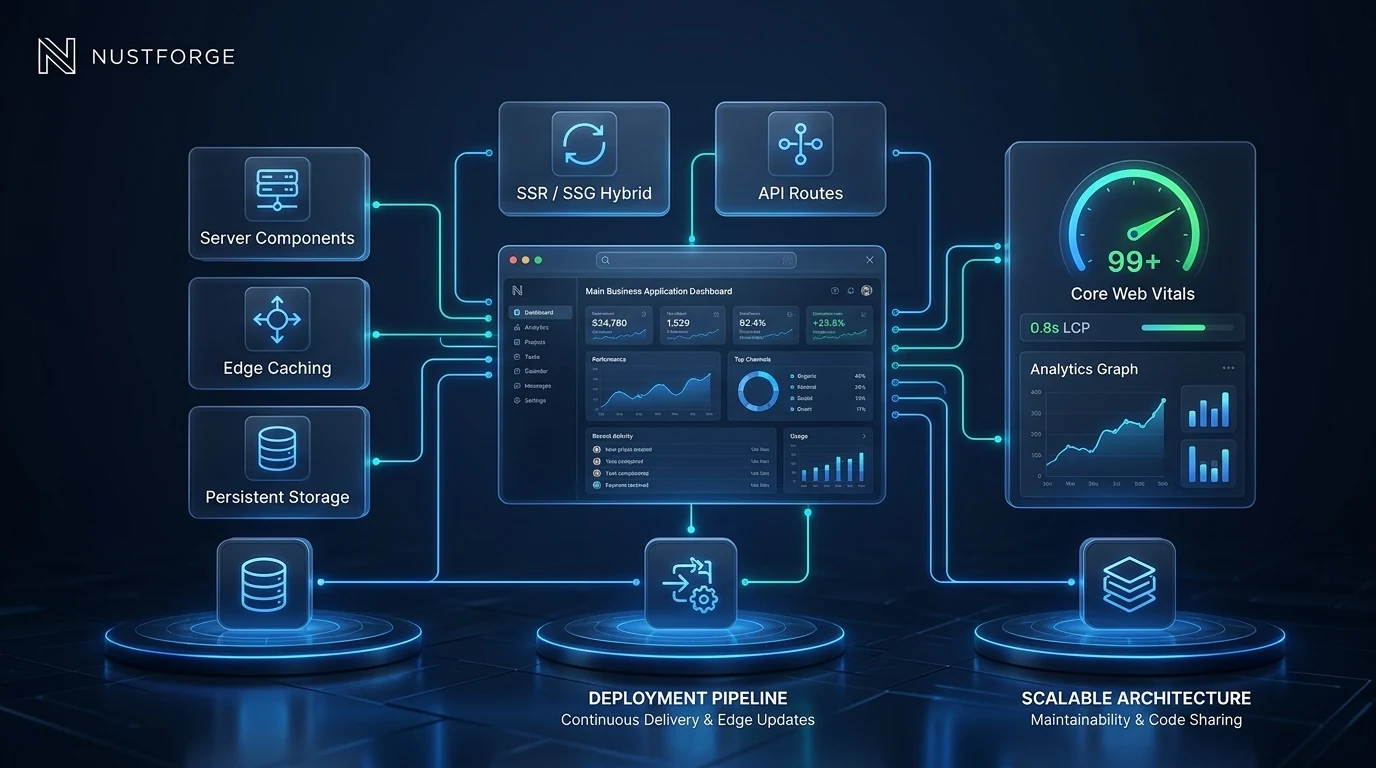
With Next.js App Router and React Server Components (RSC), business applications achieve sub-second page loads, near-zero client bundle sizes for data-heavy pages, streaming server rendering with granular suspense boundaries, and native search engine discoverability.
Unlike traditional Single Page Applications (SPAs) that require multi-megabyte JavaScript downloads before showing a login screen, Next.js renders critical interfaces on the server, ensuring immediate interactivity and flawless Core Web Vitals across all devices.
The evolution from SPAs to React Server Components
For a decade, enterprise dashboards and portals were commonly built as client-side Single Page Applications (using plain Create React App or Vite). While effective for prototyping, SPAs suffer from severe architectural limitations: massive initial JavaScript bundles, waterfall API requests, poor performance on mobile networks, and total invisibility to search engines and AI web crawlers.
Next.js App Router fundamentally resolves these bottlenecks through React Server Components. Components execute on the server during the request or build phase; their heavy dependencies (database drivers, markdown parsers, syntax highlighters) stay on the server and are never transmitted across the wire to the user's browser.
The client receives pre-rendered, lightweight HTML and CSS, with tiny interactive JavaScript islands attached only where user input or stateful reactivity is genuinely required.
Hybrid rendering: SSG, SSR, and Edge Caching
One of Next.js's greatest architectural strengths is its ability to blend multiple rendering strategies within the exact same codebase.
Public marketing pages, service directories, and blog guides utilize Static Site Generation (SSG) with generateStaticParams, pre-rendering HTML at build time for sub-50ms TTFB delivery via global Edge CDNs.
Authenticated customer portals and real-time operational views utilize Dynamic Server-Side Rendering (SSR) or streaming Server Actions, querying relational databases securely without exposing backend connection strings or credentials to the client browser.
Full-stack type safety with TypeScript and server actions
In traditional web development, frontend and backend codebases are separated by loose REST or GraphQL API contracts that frequently drift, creating runtime errors when schemas change.
Next.js enables end-to-end full-stack type safety. Server Actions and API Route Handlers share TypeScript interfaces directly with frontend forms and tables. When a database schema changes, the TypeScript compiler immediately highlights every impacted UI component during compilation, preventing silent production crashes.
Paired with modern styling solutions like Tailwind CSS v4 and strict linting rules, engineering teams achieve high development velocity without sacrificing software stability.
Core Web Vitals and international performance
Google's Core Web Vitals (Largest Contentful Paint, Interaction to Next Paint, Cumulative Layout Shift) directly influence organic search rankings and conversion rates.
Next.js provides built-in performance primitives: the Next.js Image component automatically serves AVIF/WebP formats, prevents layout shift via explicit aspect ratios, and generates responsive srcsets; next/font hosts web fonts locally, eliminating third-party Google Fonts blocking; and native script optimization governs third-party script loading priorities.
For businesses serving clients across the UK, UAE, US, and Europe, edge-distributed Next.js platforms guarantee consistent, lightning-fast response times regardless of physical geography.
How NUSTFORGE engineers Next.js business software
At NUSTFORGE, Next.js is our core full-stack platform. Every web application, agency website, and B2B SaaS platform we build is engineered on modern Next.js App Router and React 19.
Our technical executions leverage static generation for public discovery, server actions for secure data mutations, Tailwind CSS v4 design systems, and deep schema markup for AI engine visibility.
Whether you are planning a new SaaS product, custom enterprise portal, or high-converting business platform, we deliver clean, performant, production-ready Next.js software built to last.
Continue reading
Related software guides.
Business Software
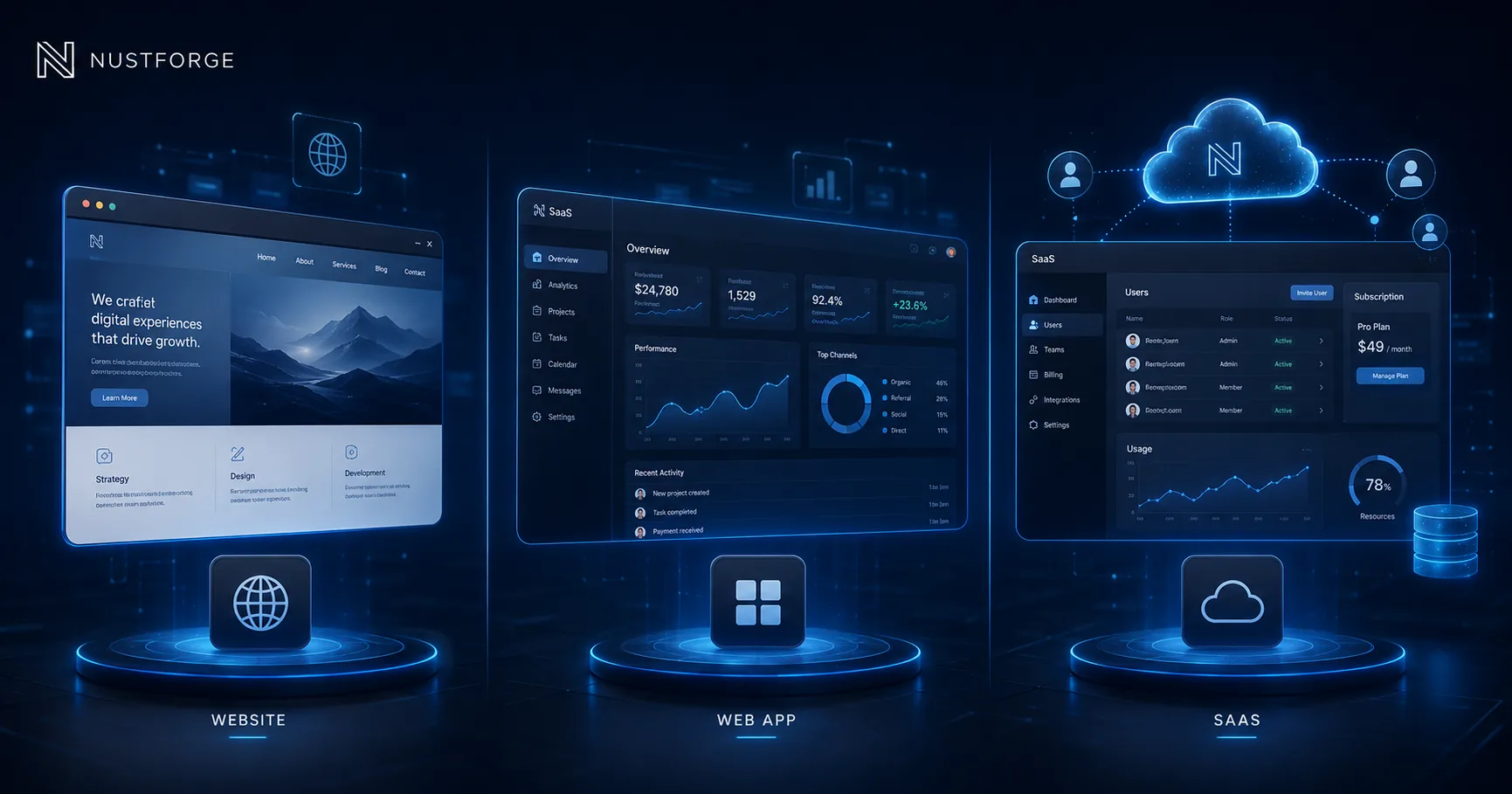
Website vs Web App vs SaaS: Which One Do You Need?
Compare a marketing website for visibility, a web app for interactive workflows, and a SaaS platform for subscription software before choosing what to build.
Read article
Business Software
Custom Business Dashboards: Features, Architecture and Development Considerations
Discover when to transition from spreadsheets to custom business dashboards, key architectural layers, real-time KPI pipelines, role-based access control, and TCO.
Read article
SaaS Development
SaaS Multi-Tenancy: Architecture, Tenant Isolation and Scalability
A comprehensive engineering guide to SaaS multi-tenancy models, PostgreSQL row-level security, tenant data isolation, noisy neighbor mitigation, and database scaling.
Read articleEngineer with Next.js
Evaluating Next.js for your next enterprise application?
Partner with NUSTFORGE to build sub-second, SEO-optimized, maintainable full-stack Next.js platforms.